
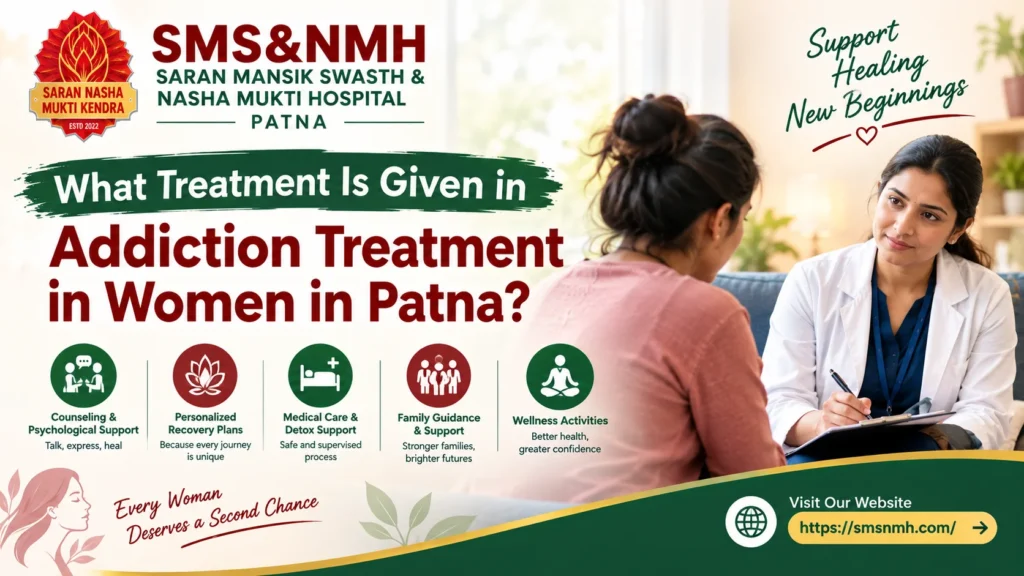
If you’re reading this because someone you love is struggling with alcohol or drugs, you already know it’s never just about the substance. It bleeds into everything else, her health, her mood, her marriage, her job, even how she sees herself in the mirror. Addiction treatment in Women in Patna is meant to look at the whole person, not just switch off the substance use like a tap. A proper plan usually brings together assessment, medical care, detox where it’s genuinely needed, counselling, behavioural therapy, family support, rehabilitation, and aftercare. What she actually gets depends on the substance, how deep the dependence runs, her physical condition, her emotional state, and what her recovery specifically calls for.
What Does Addiction Treatment in Women in Patna Usually Include?
Here’s the thing, no two women walk into treatment needing the exact same plan. Some need medical supervision from the first day because withdrawal can get dangerous. Others are ready to jump straight into counseling and a structured routine.
A solid women’s addiction treatment programme tends to cover:
- Initial assessment
- Medical evaluation
- Withdrawal management
- Detoxification when it’s clinically appropriate
- Individual counselling
- Group counselling
- Behavioural therapy
- Family counselling
- Emotional and psychological support
- Relapse prevention
- Aftercare planning
None of this works in isolation. The whole idea is to treat the addiction and whatever is standing in the way of recovery at the same time.
Addiction Treatment in Women in Patna Starts With a Personal Assessment
Before anyone talks about a treatment plan, professionals need to actually sit down and understand what’s going on with her. This first conversation shapes everything that follows.
Medical and substance use assessment
This usually digs into things like:
- Which substance she’s using
- How often she’s using it
- How long this has been going on
- Whether she’s tried to stop before
- What withdrawal has looked like for her
- Her general physical health
- Sleep and appetite
- Any medications she’s currently on
- Past treatment, if there was any
- Her family and social situation
Mental and physical health concerns often surface here too, and they matter just as much as the substance use itself. WHO guidance is pretty clear that a detailed individual assessment is central to picking the right treatment path for substance use disorders.
Detoxification and Withdrawal Support for Women
People tend to think rehabilitation basically means detox. It doesn’t. Detox is one chapter, not the whole book.
So what actually happens during detox?
Once the body has become physically dependent, stopping suddenly can trigger withdrawal. Sometimes that’s just uncomfortable. Sometimes, depending on the substance, it can turn serious fast.
During this stage, doctors and nurses are usually watching:
- Sleep and rest
- Hydration and nutrition
- Mood swings
- Physical discomfort
- Blood pressure and other vitals where needed
- Anxiety or agitation
- Anything else tied to withdrawal
How this is managed changes completely depending on what substance is involved. WHO also flags that certain withdrawal syndromes need planned, specialist attention, particularly when complications are a real possibility.
This is exactly why women shouldn’t try to just quit cold turkey on their own and hope for the best. Detox decisions need a qualified healthcare professional in the room.
Counselling in Addiction Treatment in Women in Patna
Once the physical side of withdrawal is under control, counselling takes over as one of the most important parts of the whole process. Because let’s be honest, the habits, triggers, and thought patterns that fed the addiction don’t just disappear once the substance is out of her system.
Individual counselling for women
This is her space, one on one, to talk without an audience.
Depending on what she’s carrying, sessions might get into:
- Why the substance use started in the first place
- Emotional triggers
- Handling stress
- Cravings
- Family issues
- Low self confidence
- Rocky relationships
- Coping habits that aren’t serving her
- Fear of relapsing
- Where she wants her life to go from here
This isn’t about someone lecturing her to just stop. It’s about helping her actually see her own patterns and build something healthier in their place.
Behavioural therapy and coping skills
Behavioral work helps pinpoint the thoughts and situations that quietly feed substance use. WHO recognises psychosocial approaches, cognitive behavioural therapy among them, as a genuine part of treating substance use disorders, not just an add-on.
Addiction in Women and the Importance of Emotional Support
Addiction in Women rarely shows up alone. It’s often tangled up with stress, past trauma, relationship pain, loneliness, anxiety, or depression. Ignoring that side of things during rehabilitation just doesn’t work.
A treatment environment that actually feels supportive lets a woman speak honestly, without bracing for judgement every time she opens up.
Emotional support tends to look like:
- Regular counselling
- Learning to manage stress
- A healthy daily routine
- Communication that actually feels supportive
- Activities that rebuild confidence
- Family involvement, where it helps
- Practical guidance for the hard moments
Every woman’s story is different, so treatment has to be personal and respectful rather than one size fits all.
Family Counselling as Part of Women’s Rehabilitation in Patna
Addiction never stays contained to just the person using it. Families go through their own version of it, worry, confusion, anger, money stress, trust that’s been chipped away over time.
How family support actually helps
Where it makes sense, family counselling helps relatives understand what addiction really is instead of just reacting to it, and it opens up better communication all around.
Families often come away learning how to:
- Recognise the triggers
- Encourage her to stay in treatment
- Let go of unnecessary blame
- Set boundaries that are actually healthy
- Support recovery routines once she’s home
- Respond the right way to warning signs
- Get ready for life after rehab
How involved a family gets should always be shaped by her specific situation, not a fixed rulebook.
What Happens in a Ladies Nasha Mukti Kendra in Patna?
If you’re searching for a Ladies Nasha Mukti Kendra in Patna, it helps to know that real rehabilitation is about a lot more than just keeping someone away from a substance.
A well run programme usually has a daily rhythm built around counselling, proper rest, nutritious meals, recreational time, therapy sessions, and guidance that’s focused on recovery, not just supervision.
Questions worth asking before you choose
Before settling on a facility, it’s worth checking whether they actually offer:
| Treatment area | Why it matters |
| Assessment | Helps understand individual treatment needs |
| Detox support | Helps manage withdrawal appropriately |
| Counselling | Addresses emotional and behavioural factors |
| Family support | Improves communication and understanding |
| Rehabilitation | Builds healthy routines and recovery skills |
| Relapse prevention | Prepares for future triggers |
| Aftercare | Supports continued recovery after discharge |
Honestly, the best move is just to talk to the professionals directly and ask what level of care actually fits her situation.
Addiction Treatment in Women in Patna and Relapse Prevention
Recovery doesn’t just end the day she walks out of residential treatment. Going back to familiar places and people can bring back old stress and cravings faster than you’d expect.
Building a relapse prevention plan that actually works
A realistic plan usually includes:
- Knowing her personal triggers
- Sticking with counselling if it’s recommended
- Keeping sleep and eating patterns steady
- Staying close to people who actually support her
- Steering clear of high risk situations
- Following medical advice
- Picking up hobbies that give her something to focus on
- Asking for help the moment warning signs show up
The whole point is catching trouble early, long before substance use has a chance to spiral again.
Why Individualised Addiction Treatment in Women in Patna Matters
Two women could be using the exact same substance and still need completely different care. One might mostly be dealing with emotional stress. Another might be facing serious withdrawal, family conflict, and health issues all at once.
That’s the whole reason Addiction treatment in Women in Patna needs to come from individual assessment, not a template that gets applied to everyone the same way.
Treatment planning usually factors in:
- Age and overall health
- Which substance is involved
- How severe and how long the use has been
- Past treatment experiences
- History with withdrawal
- Emotional wellbeing
- What home life looks like
- Her personal recovery goals
- How much ongoing support she’ll need
WHO and UNODC international standards describe treatment as a mix of interventions matched to the individual, with continued recovery support after the initial treatment period wherever that’s needed.
Choosing the Right Women’s Addiction Treatment Centre in Patna
Picking a centre is a heavy decision, for her and for the family around her. Don’t just go by what sounds good in an advert, look at what’s actually being offered.
Worth asking:
- Is the plan actually built around her, personally?
- Is medical supervision there when it’s needed?
- How do they handle withdrawal symptoms?
- Does the programme include individual counselling?
- Is family counselling part of it?
- Is there a clear plan for preventing relapse?
- What kind of aftercare do they offer?
- How do they protect her privacy and dignity?
At Saran Mansik Swasth & Nasha Mukti Hospital, treatment is discussed around each woman’s own situation, with real focus on professional guidance, counselling, rehabilitation, and what comes after.
When Should a Woman Seek Addiction Treatment?
The earlier help comes in, the easier it usually is to understand what’s happening and figure out the right path forward. It’s worth reaching out the moment substance use starts feeling out of control, starts hurting family or work, starts affecting her health, or keeps happening no matter how many times she’s tried to stop.
You don’t need to wait until everything has fallen apart first. Sometimes it just starts with an honest assessment and a clearer picture of what’s actually possible.
Evidence Based Information Before Starting Treatment
Alongside professional advice, families researching rehabilitation can lean on solid public health sources too. The World Health Organization (WHO) publishes evidence based guidance on withdrawal management, psychosocial interventions, alcohol dependence, drug use disorders, and recovery focused care.
Having that background makes it a lot easier to ask sharper, more useful questions when you’re actually sitting across from a treatment team.
Conclusion
Addiction treatment in Women in Patna was never meant to begin and end with detox. Real recovery usually means assessment, withdrawal management, counselling, behavioural support, family involvement, rehabilitation, relapse prevention, and aftercare, all working together.
If you’re looking for a Ladies Nasha Mukti Kendra in Patna, understanding these pieces makes the whole search feel a lot less overwhelming. What’s right for her depends on her health, her history with substance use, her emotional needs, her family, and what she wants for her future. A professional assessment is simply the place to start.
Recovery takes time. It takes patience, and it takes people sticking around consistently. With the right care and a plan that actually fits her life, a woman can build her way back to healthier routines and a future that feels stable again.
Frequently Asked Questions
1. What treatment is given for addiction in women?
It usually involves assessment, detox or withdrawal management where it’s needed, medical care, individual counselling, behavioural therapy, family support, rehabilitation, relapse prevention, and aftercare. The exact mix depends on her.
2. Is detox enough to treat addiction?
Not on its own, no. Detox mainly handles withdrawal and the immediate physical side of quitting a substance. Real, lasting recovery almost always needs continued psychological, behavioural, social, or medical support after that. WHO is direct about this too, detox alone was never meant to be treated as complete treatment.
3. How does counselling help women with addiction?
It helps her spot triggers, manage cravings, work through what’s going on emotionally, build coping skills that actually help, communicate better, and get ready for situations that could otherwise push her toward relapse.
4. What is the role of family in women’s addiction recovery?
Family brings encouragement, emotional support, healthy boundaries, and practical help. Family counselling also helps relatives actually understand addiction instead of just reacting to it, which usually makes communication a lot easier.
5. How long does Addiction Treatment in Women in Patna take?
Honestly, there’s no set timeline. It comes down to the substance, how severe the dependence is, her physical and emotional health, past treatment history, withdrawal needs, and how recovery is going for her specifically
Pingback: Women Addiction Centre in Patna | Recovery Support